“As a classroom community, our capacity to generate excitement
is deeply affected by our interest in one another, in hearing
one another’s voices,in recognizing one another’s presence.”
― bell hooks, Teaching to Transgress
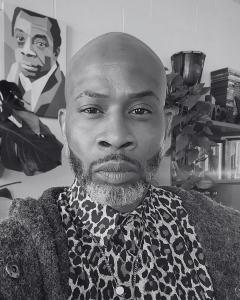
I am Al-Tariq (“Tariq”) Moore, alumnus of The University of North Carolina at Chapel Hill, and currently an Assistant Professor of English at North Carolina Central University (Durham, NC) in the Department of Language and Literature. My research examines black queer invisibility in African American novels and notions of “horror” regarding the black queer body and the black feminine writ large. Through the lens of psychoanalysis, I treat historical anxieties regarding castration, :buck-breaking,” and emasculation of black men as central to the erasures, exclusionary practices, idealisms, and fetishizations responsible for “monsterizing” black queerness. I interrogate black filmic, cinematic, and musical articulations of black queer “monstrosity” for what they reveal to us about black gay “boogie-men”—those larger than life constructions of rebellious expression that defy supression and confinement beneath the symbolic black bed. To borrow from James Baldwin, Boogie-Men are those liberated souls who are unafraid to dance “… the way [their] blood beats” even when the rhythm of their truth reveals that unfettered freedom is the hidden treasure of the margin.
Central to my work is the Morrisonian theory that both the inclusions and stratetegic erasure of black queer identities has much to reveal to us about the functioning and occupation of white supremacist thought in black imaginations of self, community, and political progress. The anxieties out of which these marginalizing practices emerge not only underscores anti-queer, but also anti-feminist patriarchal thought that labors to supress the potency of queer erotics.
I explore black queer invisibility as a form of literary and social “homelessness,” and as one of the problems facing black queer men in pursuit of “spaces” of belonging among the restrictive landscape of “American” masculinities. My work identifies strategies of reconstruction and reclamations of black queer “homespace” that are racial, spiritual, intellectual, and sexual—immune to overdetermination and impenetrable by performative demands that burden racialized expectations of gender and sexuality. More than anything, I am invested in researching possibilities for transformative reversion of the imaginary monstrous into the human.
EMAIL: emoore14@nccu.edu
PHONE: (919) 530-6764
INSTITUTIONAL ADDRESS:
North Carolina Central University
Department of Language & Literature
1801 Fayetteville Street
Farrison-Newton Communications Building
Durham, NC 27707
 altariqmoore.com